Have you ever heard of Payne’s Grey?
It’s a beautiful bluish-grey color that’s commonly used in paintings and has become a staple in the art world. But did you know that the color is named after a painter named William Payne?
Payne was born in London in 1760 and worked as a draughtsman for the Board of Ordnance before becoming a an artist in London. He was one of the first “draughtsmen” to abandon mere topographic representation for a more poetic treatment of landscape painting.
Payne was a pioneer
William Payne developed some interesting watercolor painting techniques. He was always experimenting with new methods that enhanced his art, especially the methods for rendering sunlight and atmosphere. He even abandoned the use of an outline with a pen, making his method innovative and easy to learn.
Throughout his career, Payne exhibited his works at the Royal Academy and was respected by its president, Sir Joshua Reynolds. Payne is still remembered as a significant figure in drawing history and a pioneer of modern watercolor art.
Think of William Payne
Next time you see a beautiful bluish-grey color, think of William Payne and his contributions to the art world. Consider experimenting with Payne’s Grey in your next painting. Who knows, you might just create a masterpiece!
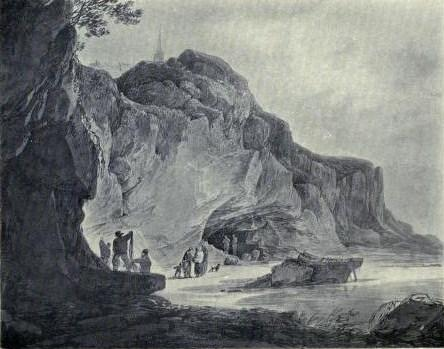
(Painting is Smuggler’s Cave by W. Payne)
Ready to Practice with Payne’s Gray?
If you are looking to practice with this beautiful color a good place to start is the Tree and Forest Fundamentals Collection – it includes 7 different landscape tutorials with a lot of opportunity to practice with Payne’s Gray.